Admin
Admin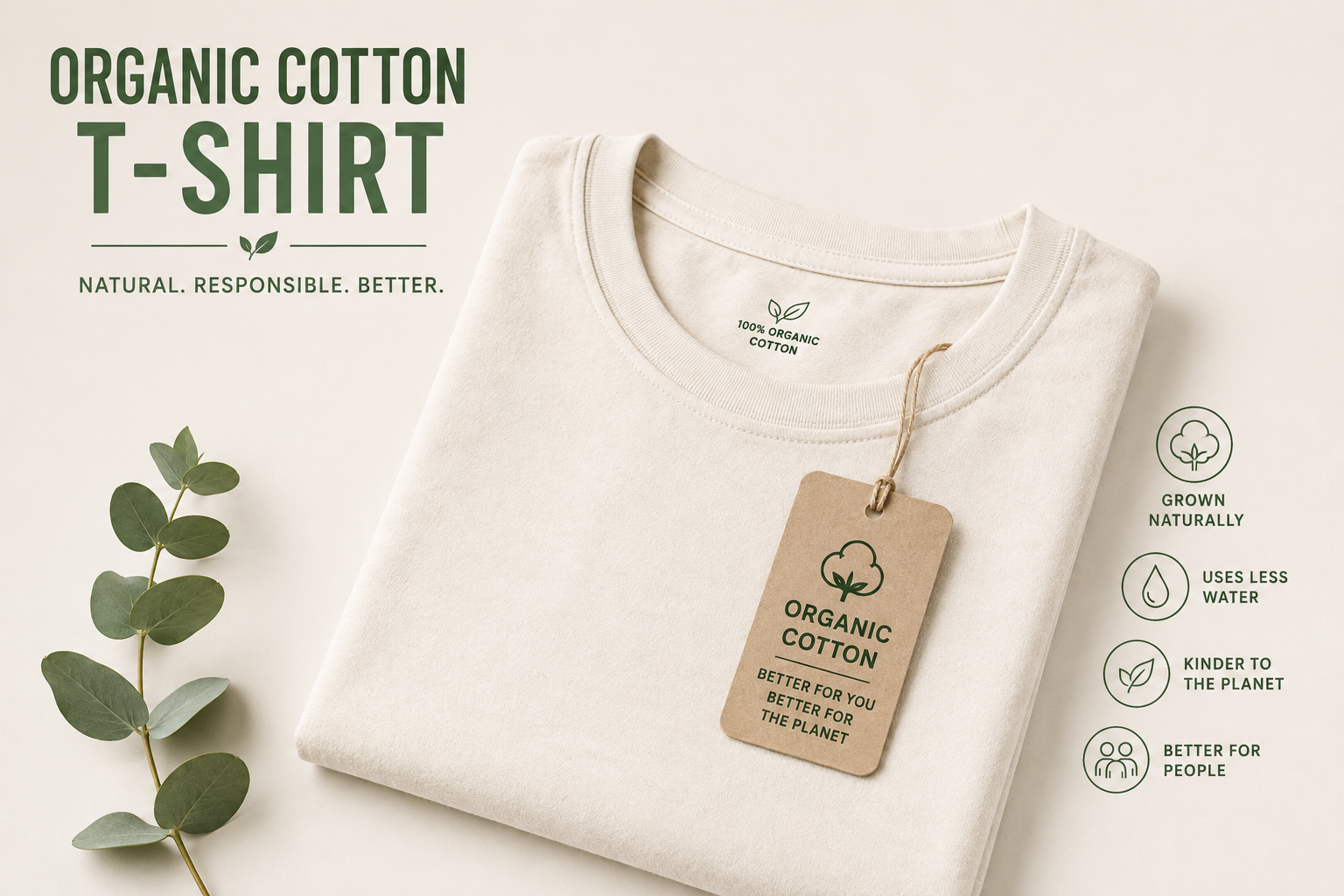
Walk into almost any clothing store today and you’ll find a rack of tees tagged “organic cotton.” The phrase has become shorthand for a better purchase — softer, cleaner, kinder. But most shoppers would struggle to explain what it actually certifies, and that gap is exactly where the marketing lives.
An organic cotton t shirt is not simply a normal tee with a nicer story attached. The difference starts in the soil, years before the fibre is spun, and it runs through seed selection, pest management, harvesting, spinning, dyeing, and finishing. Understanding that chain is the only reliable way to tell a meaningful product from a decorative claim — and to know whether the price premium is buying you anything real.
What Organic Actually Means on a Cotton Farm
Organic certification for cotton governs how the crop is grown, and the requirements are specific.
No synthetic pesticides or fertilisers. Conventional cotton is one of the most chemically managed crops in the world. Organic systems replace synthetic inputs with crop rotation, cover cropping, composting, beneficial insects, and mechanical weeding. This matters most for the people doing the work: agricultural workers in cotton-growing regions bear the direct health burden of pesticide exposure, and removing those chemicals removes that exposure.
No genetically modified seed. Most conventional cotton globally is GM, typically Bt varieties engineered for pest resistance. Organic standards prohibit GM seed, which pushes farmers toward saved and locally adapted seed stock — a resilience benefit, though it also constrains supply, since certified non-GM cottonseed is genuinely scarce in some regions.
Soil as the operating system. This is the part that gets least attention and matters most. Organic practice treats soil organic matter as the asset being managed. Healthier soil holds more water, which is why organic cotton is far more often rain-fed rather than irrigated. The often-cited figure of around 90% less “blue water” use for organic cotton comes largely from this — it reflects where the crop is grown and how the soil behaves, not a magic property of the fibre itself.
A three-year conversion period. Land doesn’t become organic overnight. Fields must be farmed to organic standards for roughly three years before the cotton can be sold as certified, and farmers absorb that cost during the transition.
Organic Versus Conventional: The Honest Comparison
The advantages are real, but so are the trade-offs, and a guide that only lists benefits isn’t much use.
On the positive side: dramatically reduced synthetic chemical load, better soil carbon, less freshwater contamination, safer conditions for farmers, and no GM seed dependency. Life-cycle assessments consistently find lower toxicity impacts for organic systems.
The complication is yield. Organic cotton generally produces less fibre per hectare than conventional — estimates vary widely by region and year, but a gap exists. Lower yields mean more land is needed for the same output, and land use has its own environmental cost. This is the strongest argument critics make, and it deserves a straight answer rather than a dismissal: organic cotton is better on chemistry, water quality, and soil health, and less efficient on land. For a garment you’ll own for years, that trade generally favours organic. For someone buying a new tee every month, no fibre choice fixes the underlying problem.
The other honest caveat is that “organic” says nothing about what happens after harvest. Cotton can be certified organic in the field and then dyed with heavy metals in an uncontrolled facility. Which brings us to the labels that actually cover the full chain.
GOTS, OCS, and OEKO-TEX: Which Certification Does What
These three get used interchangeably in product copy. They are not the same thing.
GOTS (Global Organic Textile Standard) is the strongest. It requires a minimum of 70% certified organic fibre (95% for the “organic” grade), and — critically — it also regulates the entire processing chain: prohibited chemicals in dyeing and finishing, wastewater treatment requirements, and social criteria covering wages, working hours, and freedom of association. A GOTS-certified tee is a statement about the factory as well as the field.
OCS (Organic Content Standard) verifies that the organic fibre content is what the brand claims and traces it through the supply chain. That’s it. No chemical restrictions, no wastewater rules, no labour standards. OCS is useful, but a brand citing OCS alone has told you about content, not conduct.
OEKO-TEX Standard 100 tests the finished garment for harmful substances at levels safe for skin contact. It says nothing about how the cotton was grown. An entirely conventional t-shirt can carry OEKO-TEX certification legitimately.
The practical rule: GOTS is the one worth paying for. If a product page says “organic cotton” with no certifying body and no licence number, treat it as an unverified claim.
The Certification Problem Nobody Mentions
Anyone writing seriously about this should acknowledge that the system has been abused. Investigations in recent years have documented significant fraud in organic cotton certification, particularly involving conventionally grown cotton being sold with falsified organic paperwork. Certification bodies have since tightened traceability requirements, introduced transaction certificates, and expanded DNA and isotope testing of fibre.
This isn’t a reason to give up on organic cotton. It’s a reason to prefer brands that go beyond the logo — ones that name their mills, publish supplier lists, or work with a small number of long-term partners rather than sourcing opportunistically. Depth of relationship is a better fraud filter than any certificate.
Judging the Shirt Itself: Fabric and Construction
Organic fibre tells you about ethics. It tells you nothing about whether the shirt will still look good after fifty washes. That comes down to how the cotton is spun and knitted.
Ring-spun beats open-end. Ring-spinning twists and thins the fibres continuously, producing a finer, stronger, softer yarn. Open-end spinning is faster and cheaper and yields a coarser, weaker yarn. Combed ring-spun is better still — combing removes short fibres and impurities before spinning, which is why combed cotton pills less.
Staple length matters. Long-staple and extra-long-staple cotton produces smoother, more durable fabric with fewer loose fibre ends. It’s the single biggest driver of that expensive hand-feel.
Weight, in gsm. Around 140–160 gsm is lightweight and drapey but shows wear quickly. 180–200 gsm is the sweet spot for a year-round tee. 220 gsm and above gives you the heavyweight, structured shirt that holds its shape for years.
Construction details. Side-seamed rather than tubular construction means the shirt is cut to a shape instead of a tube, so it fits properly and won’t twist in the wash. A ribbed collar with taping across the shoulders resists the stretched-out neckline that kills most tees. Double-stitched hems last.
Pre-shrinking. Organic cotton typically skips the synthetic resin finishes used to control shrinkage in conventional garments, so unless it’s been properly pre-shrunk or garment-dyed, expect some movement in the first wash. Good brands state this.
Buying Well
The premium-basics segment is where organic fibre and serious construction actually meet. Labels such as Archibald Frederitch position their tees as long-horizon wardrobe pieces rather than seasonal items, and their eco-luxury range is built around that logic — fewer styles, heavier fabric, colours that don’t date. Because a properly made organic tee costs meaningfully more than a mass-market one, it’s worth checking current offers if you’re building out several at once rather than buying piecemeal.
Whatever brand you choose, ask the same three questions: which certification, what gsm, and what construction. Any brand that can’t answer all three isn’t selling you a considered garment.
Making It Last
Organic cotton without synthetic finishes responds well to gentle handling and badly to heat.
Wash cold, at 30°C or below — it protects fibre length, colour, and shape, and it’s where nearly all the energy saving in laundry sits. Turn shirts inside out to reduce surface abrasion and protect prints. Use a mild detergent without optical brighteners or bleach. Skip fabric softener entirely; it coats fibres and reduces absorbency, and good cotton doesn’t need it. Above all, line dry. Tumble drying is what turns a well-cut tee into a shrunken, misshapen one, and avoiding it will extend the garment’s life more than any other single habit.
The Bottom Line
An organic cotton t shirt is worth buying when the certification is real, the construction is sound, and you intend to wear it for years. Under those conditions the maths works easily: a $40 tee worn 200 times costs less per wear than a $10 tee replaced every season, and the environmental difference compounds in the same direction.